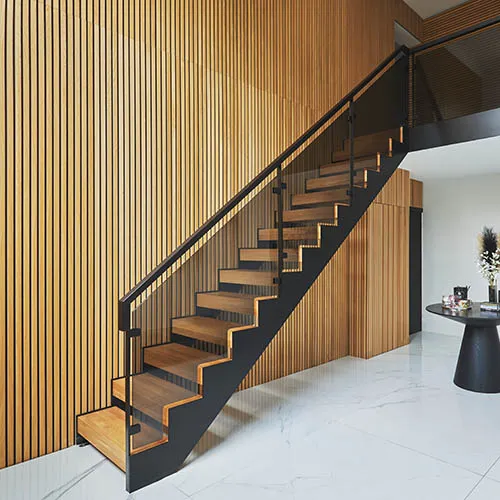
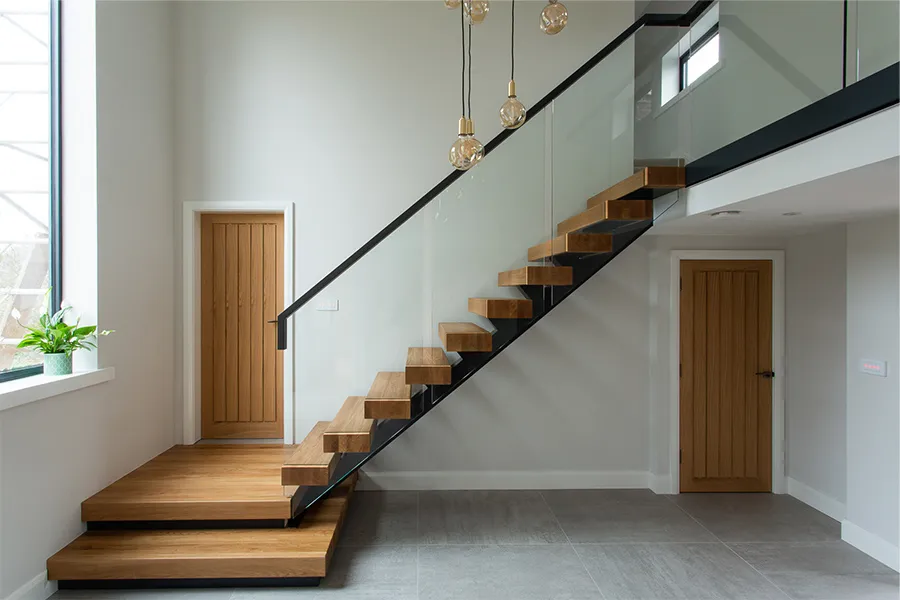
Floating staircases may appear gravity-defying, but when with Approved Document K in mind, they are fully legal and safe in the UK.
Which Building Regulations Apply to Floating Stairs?
In the UK, floating stairs are governed by the same building regulations that cover all other staircase types. All staircases, residential and otherwise, must comply with the provisions of Approved Document K, which aims to reduce the risk of falling, collision, and impact.
The most relevant sections for private homes are:
- Part K1: Covers staircases, ladders, and ramps, and governs geometry that includes the rise, going, pitch, width, and headroom.
- Part K2: Covers protection from falling, and governs guarding, handrails, and balustrades where there is a risk of falling.
Since building regulations focus on performance, not appearance, there are no restrictions on specifically floating stairs, provided that they’re safe for everyday use. It’s also important to understand that Building Control officers assess stairs based on how the property will be used, and private homes are typically given more leeway than commercial buildings; however, homeowners must still be able to demonstrate compliance through drawings and structural calculations when required.


Open Risers, Floating Treads, and Geometry: What is Allowed?
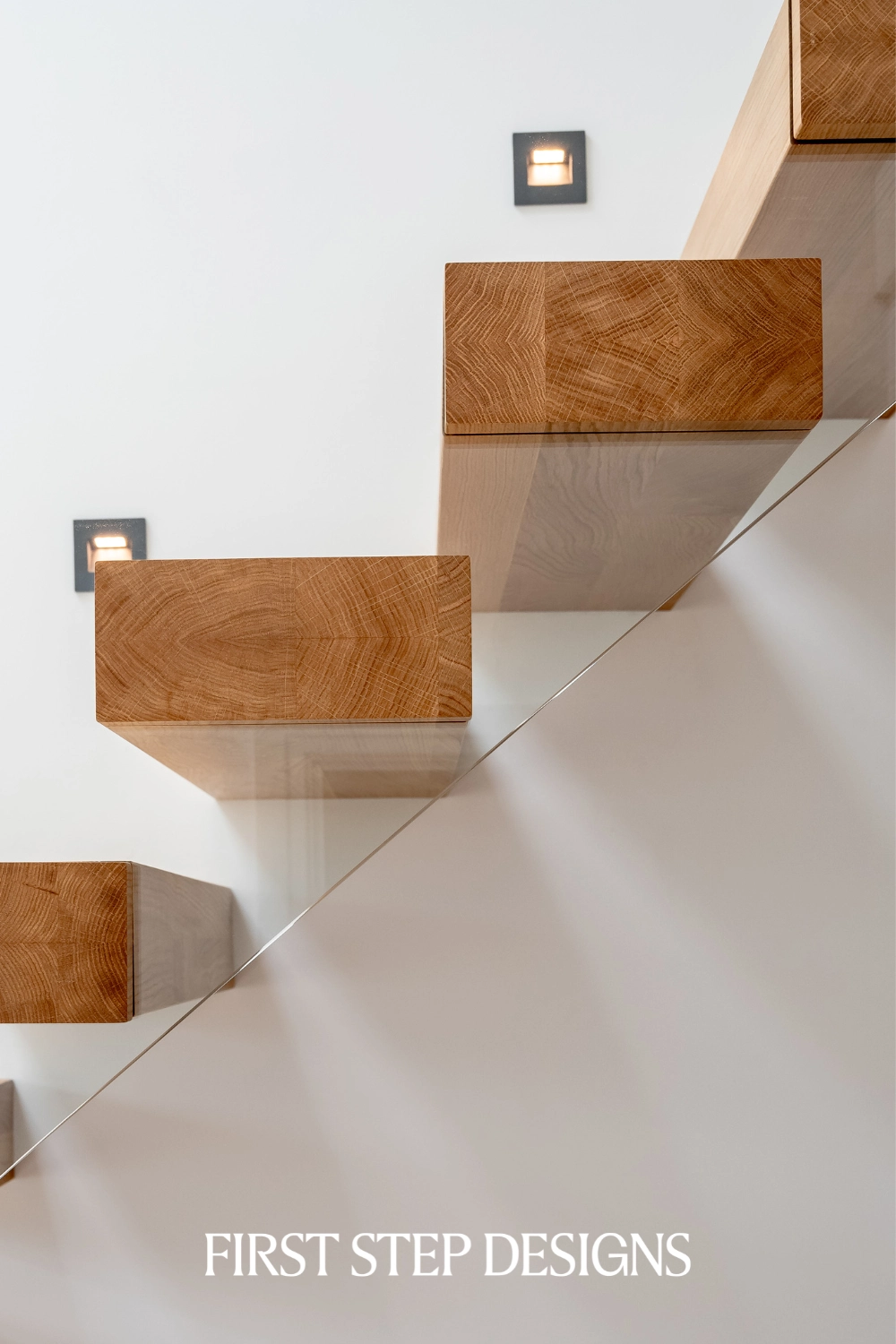
Much of the concern surrounding floating stairs is centred around their open risers. To many, they might feel like a tripping or falling hazard, especially if there are young children or the elderly in the home.
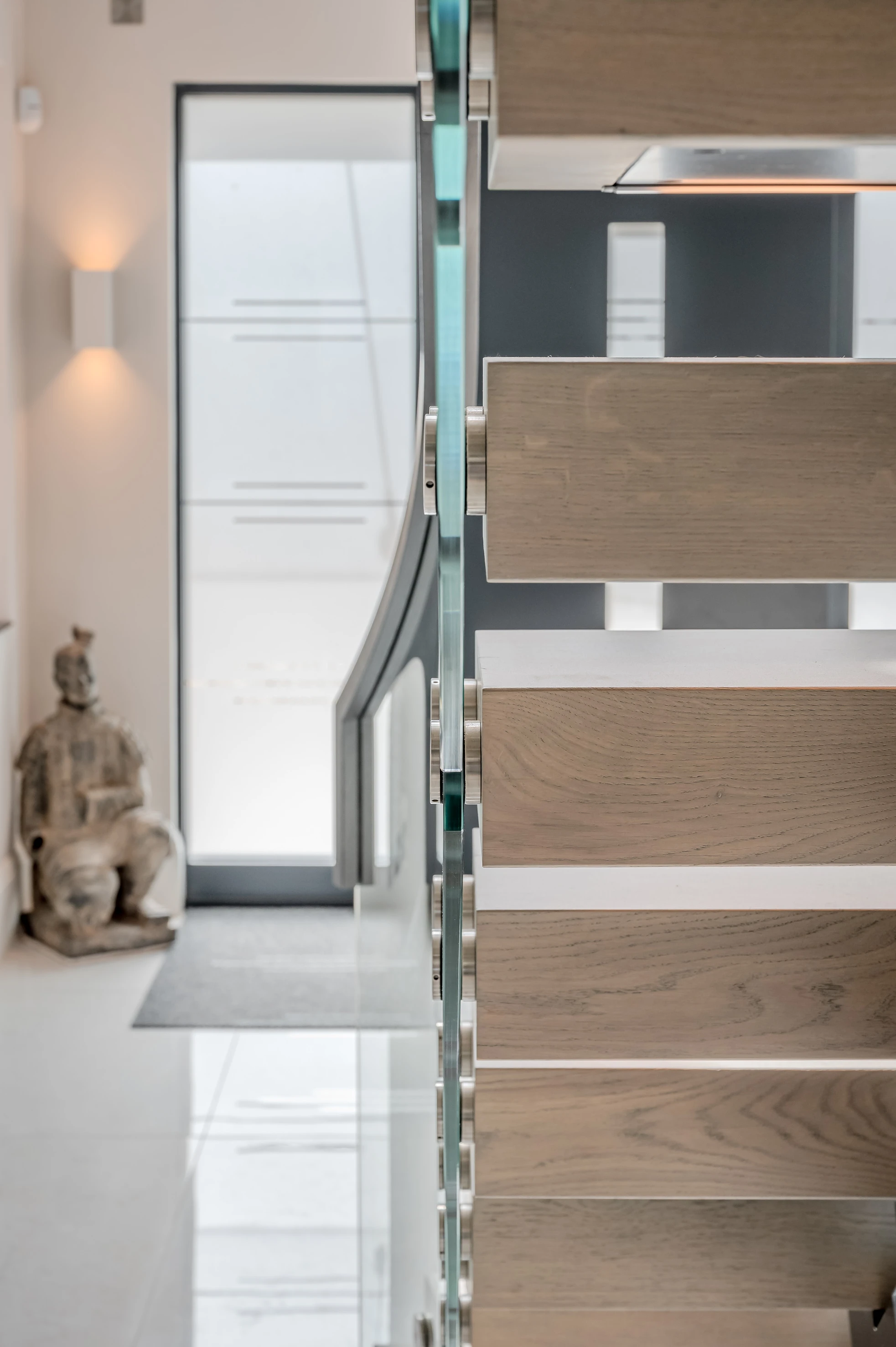
To prevent this, all types of staircases must comply with the 100mm sphere rule. It states that any gap in the stairs—whether the gap between treads or between the stairs and any adjacent elements—must allow a sphere with a diameter of 100mm to pass through. This is small enough to ensure that even small children don’t get trapped or fall through the gaps.
Other geometry covered in Approved Document K, Part K1, includes:
Consistent rise and going
Since even minor variations in step height or depth can significantly increase the risk of tripping, all steps within a single flight must be uniform.
In private homes, steps must fall within the following dimensions:
- Rise (height of each step): 150mm to 220mm
- Going (depth of each step): 220mm to 300mm (measured from nosing to nosing)
To ensure that the staircase is comfortable, designers use a formula that states that twice the rise plus the going must fall between 550mm and 700mm (2R + G = 550mm to 700mm).
Tread overlap on open risers
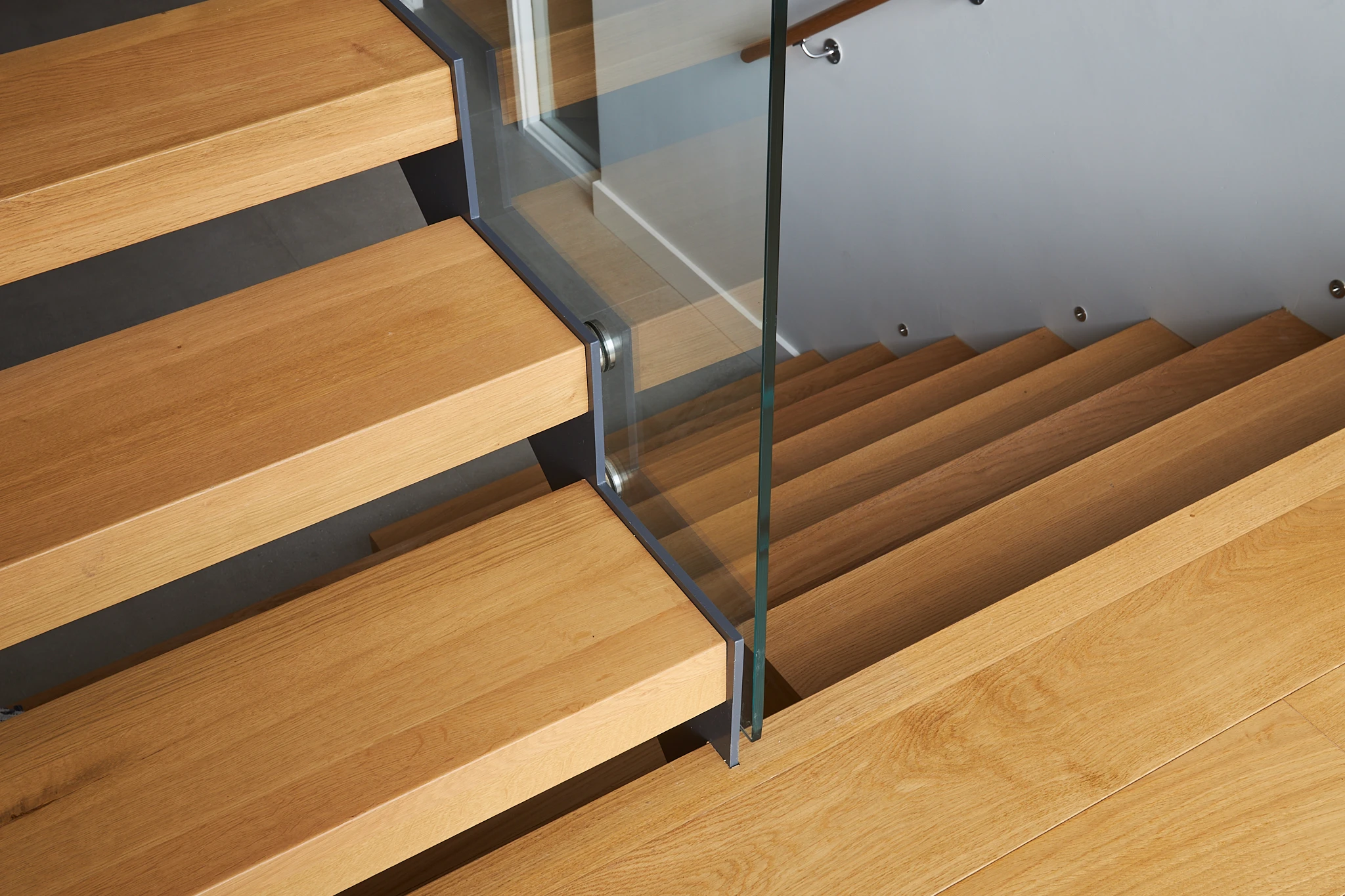
In staircases with open rises, such as floating stairs, treads must overlap by a minimum of 16mm to reduce the risk of one’s feet slipping between steps.
Maximum pitch
Stairs in private homes may not exceed a pitch (steepness) of 42°.
Headroom
Staircases must allow at least 2m of headroom across each flight.
Guarding, Handrails, and Building Control Approval
While floating stairs are defined by their openness, they must provide protection from falls as per Part 2 of Approved Document K. In practice, this means minimum requirements for guarding, balustrades, and handrails.
Guardrails and balustrades
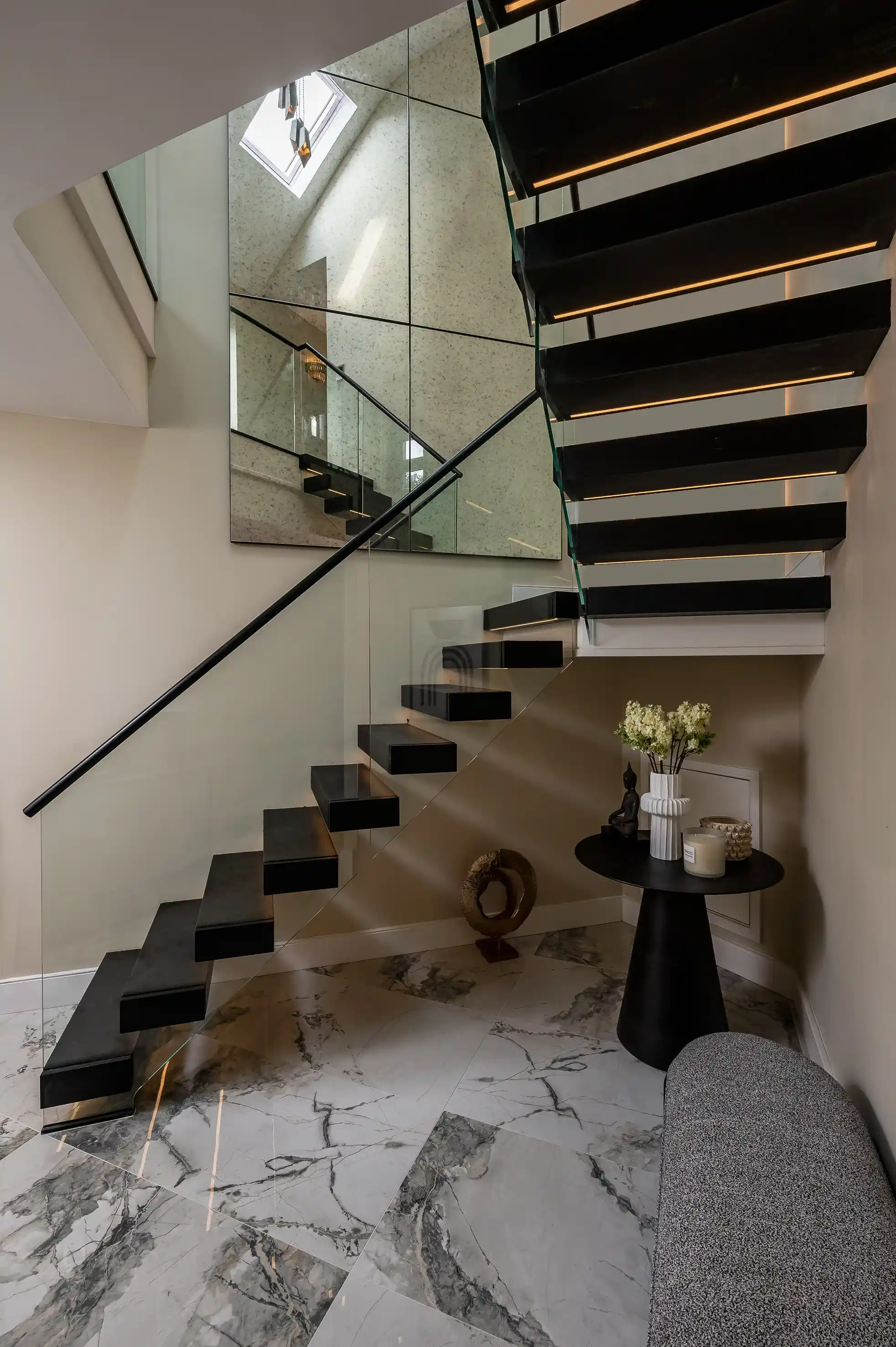
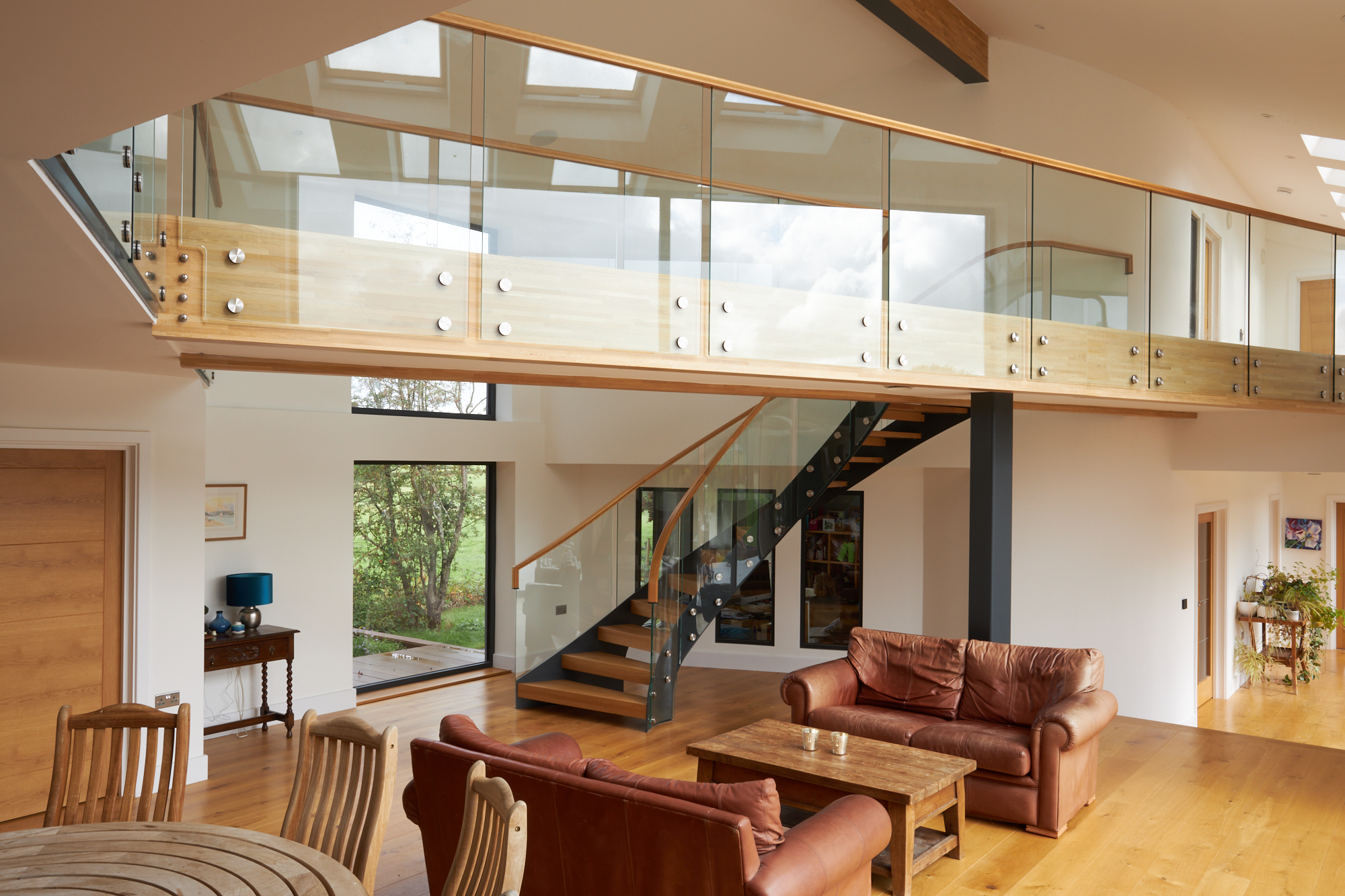
Private homes require guarding wherever there is a drop of more than 600mm. In practice, this means that virtually all floating stairs—with the possible exception of a one or two floating steps to a higher level—will require some form of balustrade (glass is a popular choice as they provide fall protection while maintaining open sightlines).
Guarding must meet the following requirements:
- Minimum height of 900mm on flights and landing areas with two or more risers.
- Pass the 100mm sphere test to ensure that children cannot climb through or become trapped.
- Must not be easily climbable, especially in private homes.
Handrails
Handrails make staircases significantly safer to use across all demographics, and must be present on all floating stairs that connect floors.
Approved Document K requires that:
- Handrails should be positioned 900mm to 1000mm above the staircase’s pitch line.
- Staircases feature handrails on either side if it is more than 1000mm in width.
While not specifically requirements for private homes, handrails typically feature easy-to-grip profiles and are designed not to project into the stair width in a way that obstructs use.
Building Control approval
Despite the many regulations that they must comply with, floating staircases are routinely approved, even when the design is fully bespoke. In almost all cases, staircase designers and manufacturers will craft their staircases with building regulations in mind, ensuring compliance and a seamless install.
If you’re planning on enhancing your home with a floating staircase, ensure that your chosen specialists provide you with:
- Structural drawings that show the rise, going, pitch, and guarding heights.
- Evidence that all gaps in the staircase pass the 100mm sphere test.
- Structural calculations that demonstrate the stairs' and the guarding's ability to bear loads (see final section for more details)
Typically, compliance issues only arise when the client subcontracts different aspects of the project to different contractors who don’t coordinate their efforts, leading to costly redesigns and delays down the line.
Structural Loads and Engineering Requirements
Beyond the scope of Approved Document K, which deals with geometry and fall protection, all staircases in the UK must also comply with structural load requirements as set out in BS EN 1991-1-1 (Eurocode 1), the UK National Annex, and BS 6180:1995.
According to these documents, residential floating stairs must be engineered to:
- Resists a concentrated load of 1.4 kN applied at the most unfavourable position.
- Have a balustrade horizontal line load of no more than 0.36 kN/m.
These documents also state that handrails and guardings must be able to resist loads without excessive movement, and that only toughened or laminated safety glass be used in balustrades.
Structural considerations in renovation projects
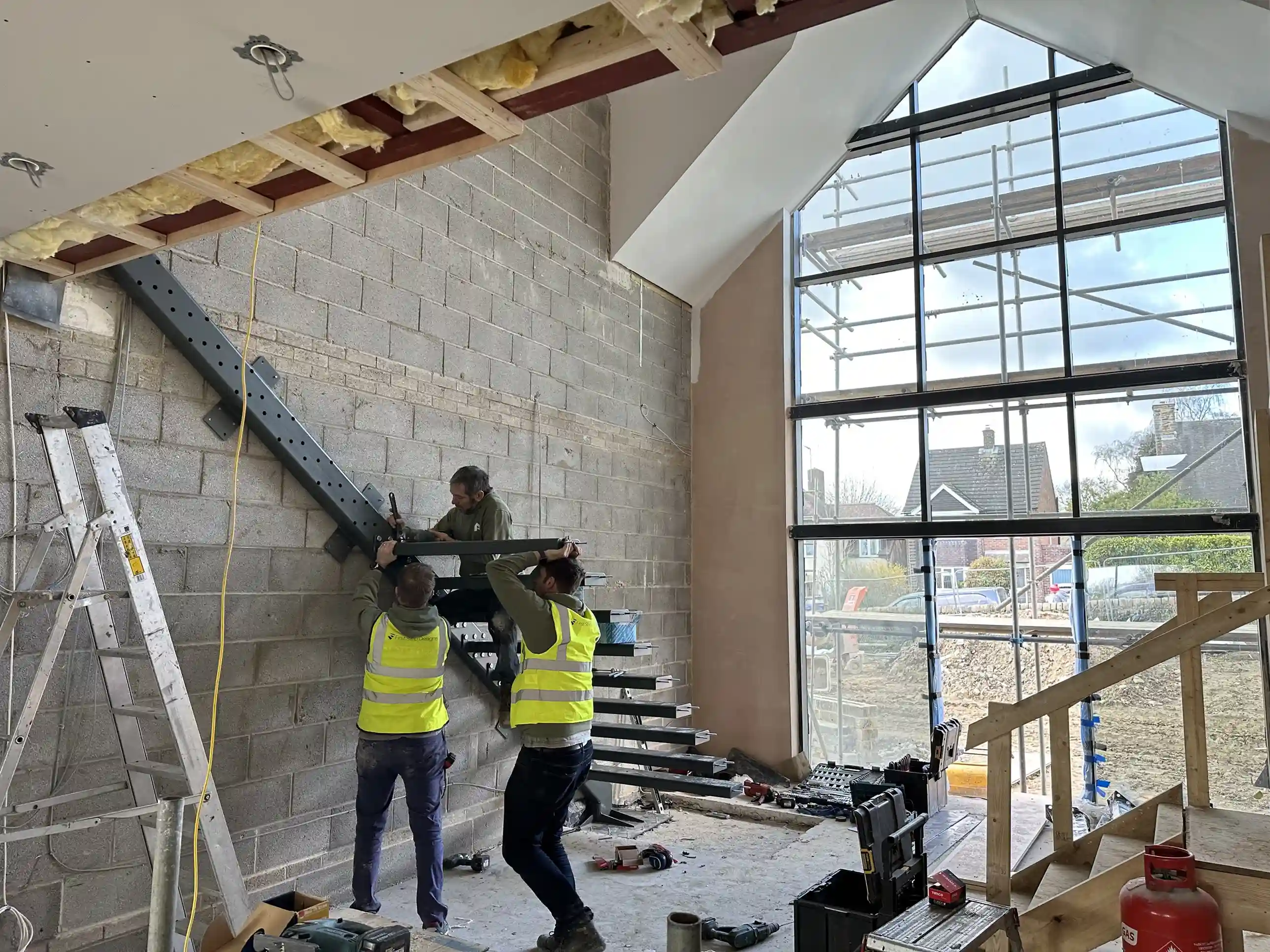
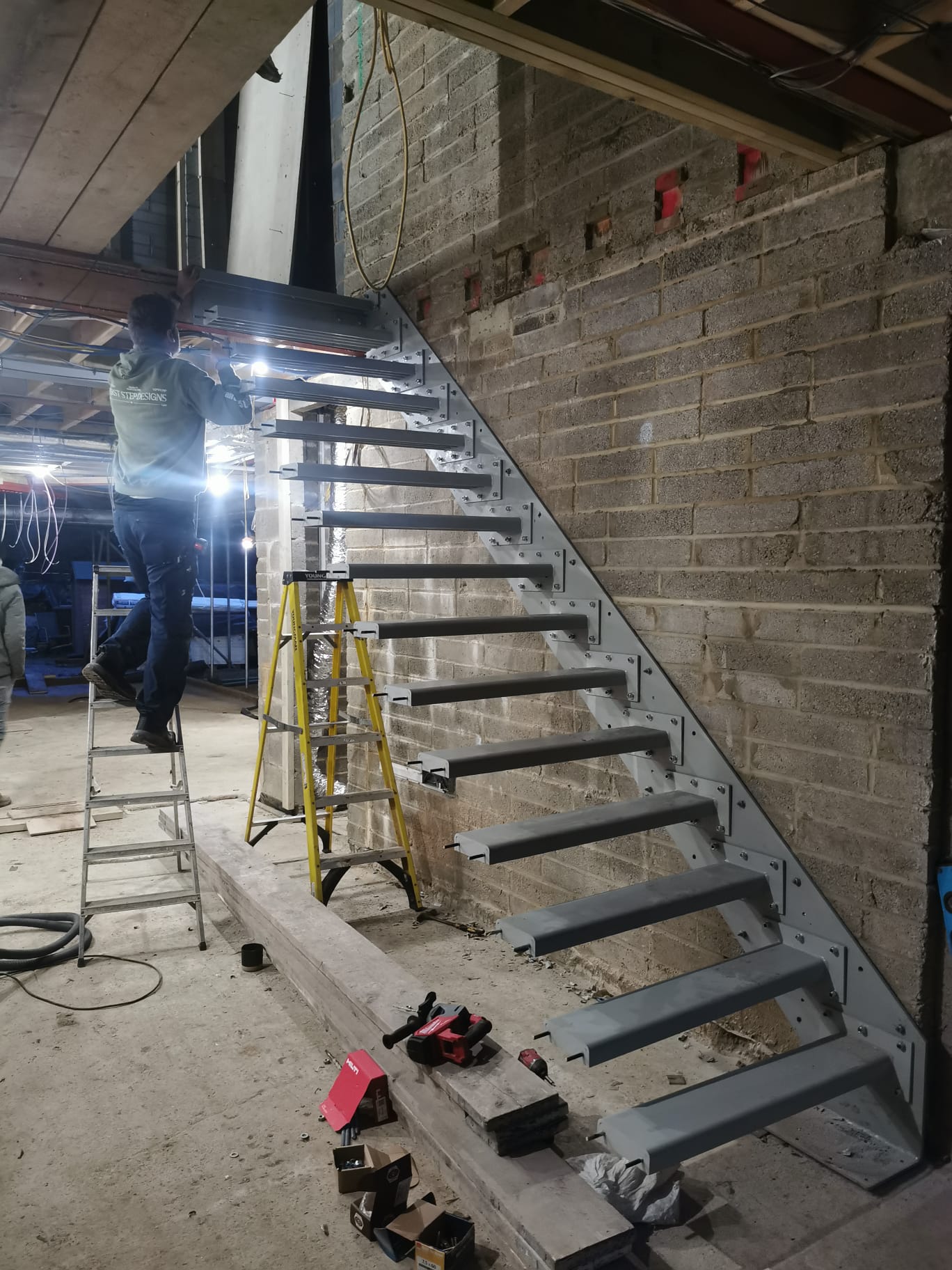
Structural considerations become especially important when floating stairs are installed in existing properties, especially older ones. Most walls aren’t designed to bear cantilevered loads, and structural testing and engineering assessments may be required to ensure long-term safety.
As responsible designers and installers, we sometimes have to turn down work when we determine that the wall is not suitable or requires extensive modification. We encourage you to be wary of contactors who do not perform structural load tests or a detailed structural analysis.
Check out our other blog posts on floating staircases to learn more:
Let's talk
Get in touch and let us show you how we can transform your home.




.jpg)